
 Written by
 | Region | Multiple continents |
| Biome | Wetlands |
| Type | Animal |
| Home Planet | May 155b |
| Status | Extant |
| Creator | Dupers, Artnoob100, Oreosaurs |
| Art by | Artnoob100 |
| Canonical Status | Canon |
| Copyrights | CC BY-NC-SA 4.0 |
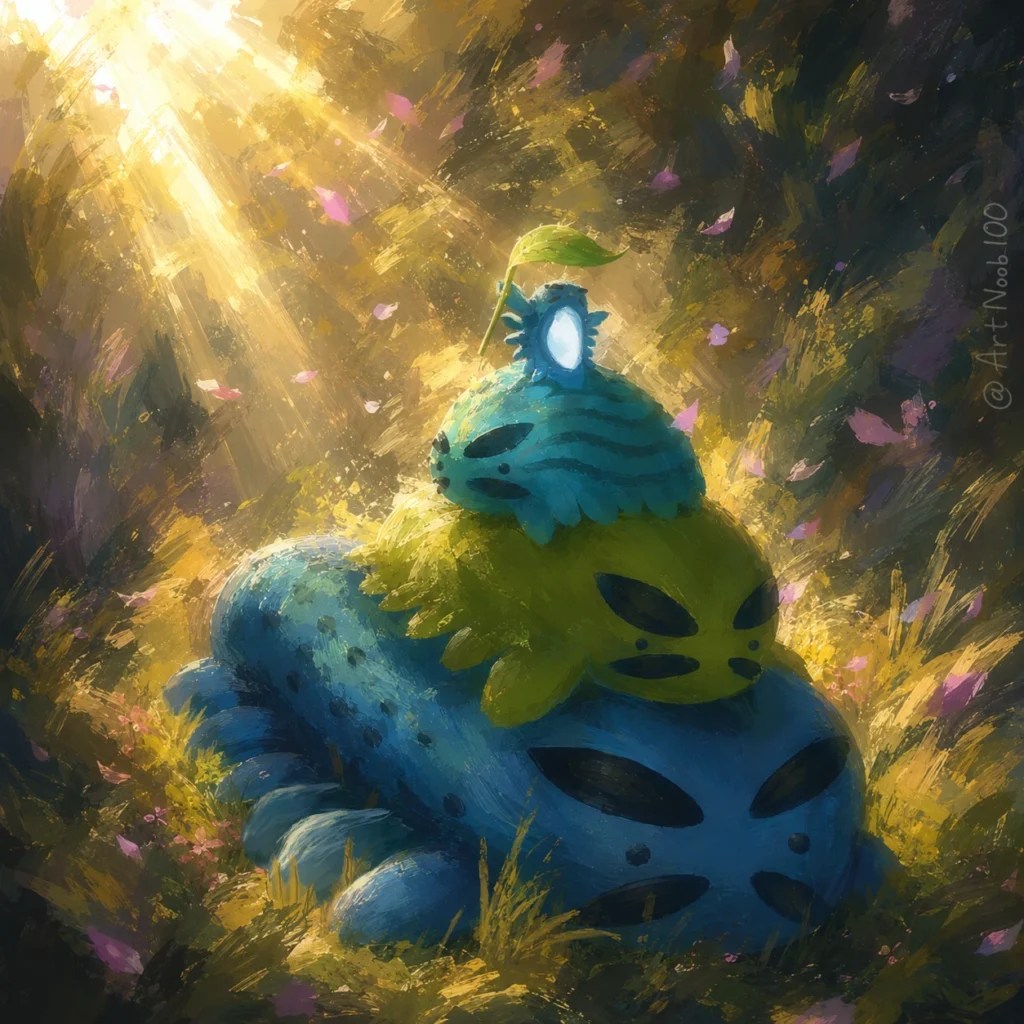


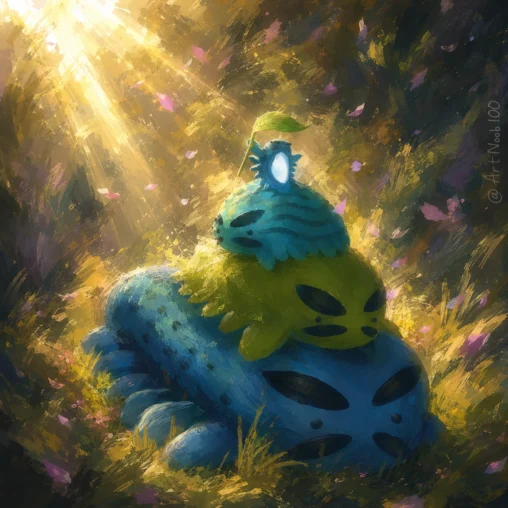
On the planet, May 155b, life had only recently begun to make a foray onto the land when Vakra researchers first discovered it. Simple tree-analogs carpeted the shorelines and emerging wetlands. There, amongst mud and moss-like growth, researchers found the first species to colonize these new terrestrial environments: the semi-aquatic Hexoarm.
This bean-shaped herbivore is a product of hybrid speciation – descending from the aquatic Hexoable and Armstrong.
The Hexoarm species features a number of adaptations that allow it to thrive in its environment. Their limbs, initially adapted for aquatic movement, underwent gradual modifications. The bone plate that once restricted its ancestor’s range of motion became even more flexible and adaptable. This allowed the Hexoarms to navigate diverse landscapes, utilizing their arms for a wide range of activities, from climbing trees to manipulating objects with remarkable dexterity.
Unlike their aquatic ancestors, the Hexoarms boast a more complex pulmonary system that enables efficient respiration on land. While cutaneous respiration still played a role, the ability to breathe air allowed them to explore territories far beyond the water’s edge.
This transition in respiration has, in turn, triggered significant changes in their circulatory system, enhancing their endurance and adaptability to varying environments.
Some of the Hexoarms were taken for study and later rehabilitated on the Great Ark, Infinity Horizon. The researchers were uncertain if such a primitive species that lacked a fear response would ever survive in their new, more complex environment, but, to their surprise, the Hexoarms thrived and multiplied.
At present, the Hexoarm species has been undergoing explosive evolutionary radiation, giving rise to a plethora of new species, each with unique adaptations suited to its specific niches. Some of these new offshoots retain the vibrant colors and patterns of their Hexoable ancestors, enabling them to communicate and camouflage effectively in their diverse habitats. The range of sizes among Hexoarm species diversified as well. Some remain small and nimble, favoring agility in their pursuit of prey or evasion of predators. Others, much larger, had evolved to harness their strength and size advantage to dominate their respective niches.
| Work used or referenced | Azula 155B |
| Creator | Oreosaurs |
| Usage note | derivative work |
| Source hyperlink | Link to original |