
 Written by
 | Region Type | Continent |
| Dominant Species | Humans, Mastikhors, Desert Worms |
| Primary Languages | Hadafi |
| Population | 4.2 million |
| Area | 29 million sq km |
| Historical Status | Ark’s breadbasket |
| Creator | Artnoob100 |
| Art by | Artnoob100 |
| Canonical Status | Canon |
| Copyrights | CC BY-NC-SA 4.0 |
Even after the ark was sealed off and chaos followed, some settlements retained relatively unimpacted – a consequence of geographic luck of being present in a place of ample natural resources. One such region was Lal Hadaf, a lush tropical continent enclosed on all sides by snow-capped mountain ranges whose glaciers fed great rivers that flowed year-round.
However, Lal Hadaf’s fate would forever change when its administration decided, despite the vocal protests of experts, to introduce some 100 mastikhors to the ecosystem as a form of biological control of agricultural pests. The introduced mastikhors began to multiply rapidly, lacking any natural predators or disease risk, and finding the local climate extremely ideal. Before long, immense swarms spread across the continent, consuming every source of biomass in their path and growing ever larger.
The administration tried many desperate measures to control the mastikhor numbers, even nuclear bombardment, but nothing could stem the ruthless tide of this ravenous flood. Eventually, a mass evacuation was called, but it was done haphazardly, and many of the denizens were left trapped by the very mountains that had once sheltered them from the outside world.
Most of those left behind perished. Others escaped into the continent’s cool alpine valleys and high plateaus, where temperatures remained too low for the mastikhors to survive.
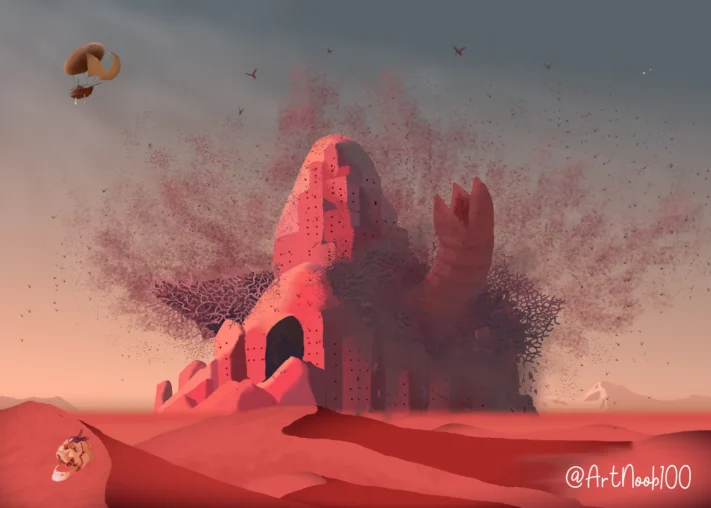
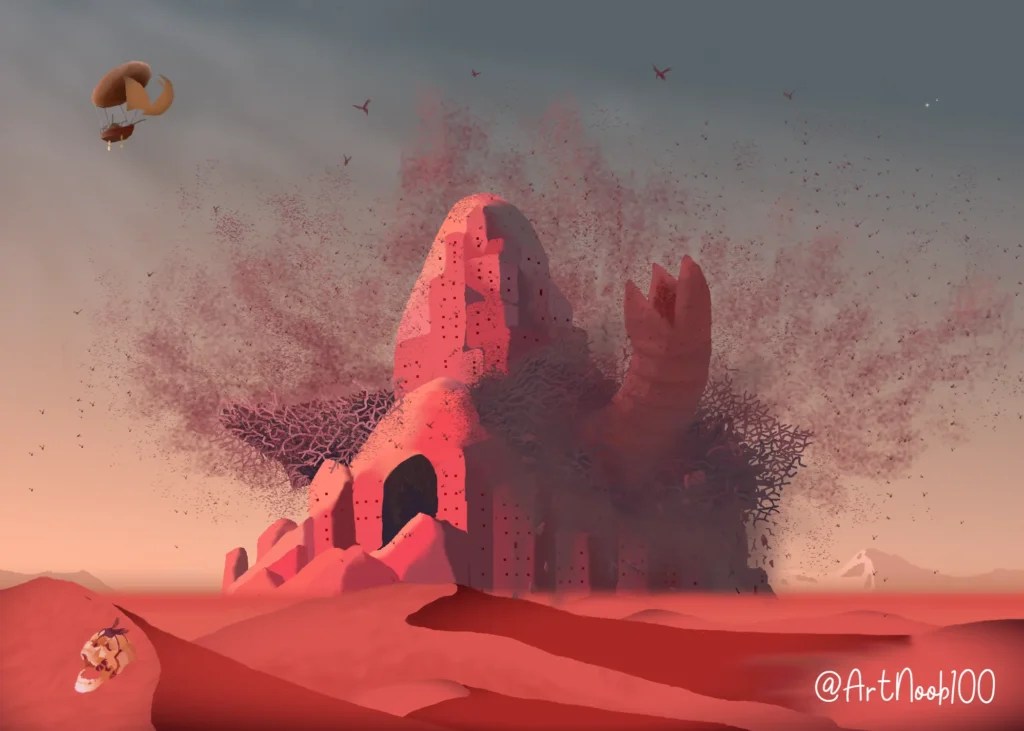
Lal Hadaf today a desert wasteland. The mastikhors dominate nearly the entire lowland interior; so numerous they are now that their countless swarms give the landscape a crimson hue. Across its eroded and stripped surface lie the ruins of once splendorous human cities, highways, and monuments. The lands have become devoid of most life, having long been consumed by the swarm. The colossal desert worm, another introduced species, is the only other prevalent species here and rides the depths of the interior’s shifting sands.
Yet, in contrast to the grounds below, the high-altitude ‘islands’ still manage to support thriving ecosystems and some even complex human societies. Having been isolated for thousands of years, each island has cultivated its own distinct cultures and ecosystems. Most of these human cultures are rather primitive, having forgotten much of their original technological heritage and knowledge of the world that originally was, with the ancient past now relegated to myths and legends.
Near the Iron Mountains, however, a different future is beginning to take shape. Rich mineral deposits and centuries of accumulated craftsmanship have given rise to an emerging industrial society. With the recent invention of airships, its people are slowly overcoming the natural barriers that isolated them for millennia, setting the stage for the first meaningful contact between the mountain civilizations in ages.
Geography
The geography of Lal Hadaf is split into two major dominions – the Black Sea and the Red Sea.
The Black Sea is a deep, inland sea named not for metaphor but for its very real biochemical corruption. Its waters are stained dark from centuries of organic runoff, decomposing biomass, and anaerobic algal blooms.
Salty, acidic, and reeking of death, it’s said the sea now “breathes” – venting black gas when temperatures run hot. Little life survives beneath, but of the ones that do, most are blind, bioluminescent, and better left undisturbed. The surrounding coastlines, long stripped bare by the mastikhor, are jagged and lifeless.
The Red Sea, in contrast, is a dried-up wasteland claimed by innumerous swarms of mastikhor. Its name comes from the very soil, oxidized and trampled under trillions of mastikhor bodies. Once home to rivers, rainforests, and cities, now it’s a land of buried ruins, rot, and shifting dunes.
Near its center lies Crater Lake, a volcanic caldera filled with cobalt-blue water and ringed by cliff settlements. Its western boundary is dominated by the Ridge Mountains, a towering spine that catches the last of the rain and provides a refuge to isolated highland settlements and scattered nomadic tribes. Further south, the Zaati Tableland sprawls – dry but liveable, home to horse clans, terrace farms, and stubborn old traditions.
Meanwhile, the east is dominated by the Koh Mountains, sharper and more hostile than the Ridge. In their shadow lies the Namkeen Plateau – a high, windblasted expanse dotted with stone-built hill towns and the last vestiges of structured states. Further to the north, the land breaks apart into cold-island masses: Asmati and Yakeen, mist-veiled, forested, and largely autonomous.
At the very northern fringe sits the foothills of Vala Yoni [Iron Mountains]. Here, a bleak industrial settlement clings to the frostline, home to crude science and a memory clawing its way back.