

 Written by
 Overview
Brrla nrr Lah ( The Language of Everything) is a minimalist conlang (constructed language) designed for use in the grand fictional setting of Infinity Horizon.
The language is noted for its extremely limited vocabulary, putting the focus on essential communication. The concept of creating new words by combining existing ones is a strong feature, allowing the language to evolve and expand without adding too much complexity.
Grammar-wise, it follows the OSV word order. This, along with a lack of verb conjugation for tense, person, or number, and straightforward modifiers, makes the language easy to learn and use.
In-Universe Lore
Rula de ezka, zaura lanjo ye
Often considered to be the lingua franca of the Tweedum, Brrla nrr Lah is actually a pidgin incorporating elements of several languages. Although dominant, existing languages were pushed on the factory floors of TRAPPIST-1; these workshops quickly became stellar melting pots of different cultures, and the simple language allowed the diverse workers to communicate more efficiently and effectively. From its meager beginnings, Brrla nrr Lah spread to become the working-class argot of the Tweedum.
With its roots in industry, the limited vocabulary of Brrla nrr Lah describes mostly objects, their functions, and interpersonal relationships. Little else is necessary to do a day’s labor and have a drink with coworkers; however, the abridged dictionary of the pidgin language has gaps that need to be filled when more complex situations arise. The Tweedum have three solutions: loanwords, compound words, and idioms.
The loanwords often incorporated into Brrla nrr Lah are mostly sourced from the Tweedum languages, which shaped its beginnings. As Brrla nrr Lah was almost always a second language to its speakers, words from its parent languages would often sneak into the hurried speech of workers. Loanwords from various Human and Bea’viskar languages which agreed with Tweedum biology would also find their ways into Tweedum homes. For example, a variation on “okay” is a common affirmative within the orbits of TRAPPIST-1.
Compound words are another common means of adding necessary complexity to Brrla nrr Lah. This could be as literal as combining “bal” and “pitkar” into “balpitkar,” meaning “long reptile,” (i.e. “snake”), or it could be more metaphorical, such as “atma” (essence, spirit, soul) and “ghun” (noise, sound) combining into “atmaghun,” which can refer to anything from crying to music.
The last core method of adding complexity to Brrla nrr Lah would be idioms. These are often highly localized and context-based, and they are almost always constructed entirely of compound words to give them the specificity needed to convey meaning. Although many of these idioms are ephemeral slang lasting at most a decade before fading into obscurity, several still in use refer to long-dead workers who were among the first to make catastrophic mistakes in the early days of the pidgin. Centuries later, Tweedum can only describe “sleeping on the job” in Brrla nrr Lah by invoking the name of a foreman and the factory which burnt down on their watch.
Grammar
Brrla nrr Lah is a minimalist constructed language with a small vocabulary and simple grammar. Here are the key aspects of its grammar:
Word Order: The basic word order in Brrla nrr lah is Object-Subject-Verb (OSV).
Object: The direct object comes first and is preceded by the particle “tu.”
Example: Tu taca (the Insect)
Subject: The subject comes second and is typically a pronoun or noun.
Example: “yak” (I), ” Tus” (you), “aray” (he/she/it/they).
Verb: The verb follows the subject. Brrla nrr lah verbs do not conjugate for tense, person, or number.
Example: “yamyam” (to eat), “chal” (to move).
Sentences:
“tu taca, aray aud.” (“He sees the bug.”)
” Tu sabri, yak yamyam.” (“I eat the fruit.”)
Modifiers: Adjectives and adverbs come before nouns or verbs they modify. There is no explicit distinction between adjectives and nouns.
Example: “yazu waya” (good person), ” Chatu gar” (small house).
Possessives: Possession is indicated by placing the possessor after the thing possessed, separated by the word “rrk.”
Example: “Lisa tu Gar rrk” (Lisa’s house).
For implying unconventional meanings, the word will be followed by (!).
Example: “Lisa tu Gau! rrk” (Lisa’s nose).
Prepositions: Brrla nrr lah uses a limited set of prepositions to indicate relationships between words.
Example: “Yla” (in, at, on), “madayam” (with, using).
Particle “Y”: Used for commands or vocatives and always comes before the word in question.
Example: “Y yamyam” (“Eat!”), “Y waya” (“Person!”).
Questions: Yes/no questions are formed by adding “ya” (or) at the end of sentence.
Example: ” yamyam, Tus ya?” (“Are you eating?”).
For open-ended questions, question words like ” Keya” (what) are used.
Example: “Kaar, Tus keya?” (“What are you doing?”).
Negation: Negation is formed with the word “Kali” after the verb or at the end of a sentence depending on context.
Example: ” Yamyam, yak kali.” (“I do not eat.”), ” Tu taca, yak aud khali.” (“I do not see the bug.”).
Emotion: When expressing a certain emotion, the word for the associated color must be followed by “!”
Example: ” Guzha!, yak.” (“I am angry.”),
Compound Words: New concepts are often created by combining existing words. There is no space in compound words unless in the case of some prepositional phrases.
Example: “Balpiktar” (Snake, literally “rope reptile”), “Brrlagg” (Radio, literally “talking box”, “bararulapiktar” (Godzilla, literally giant god repitile).
Script (Tu jaad)
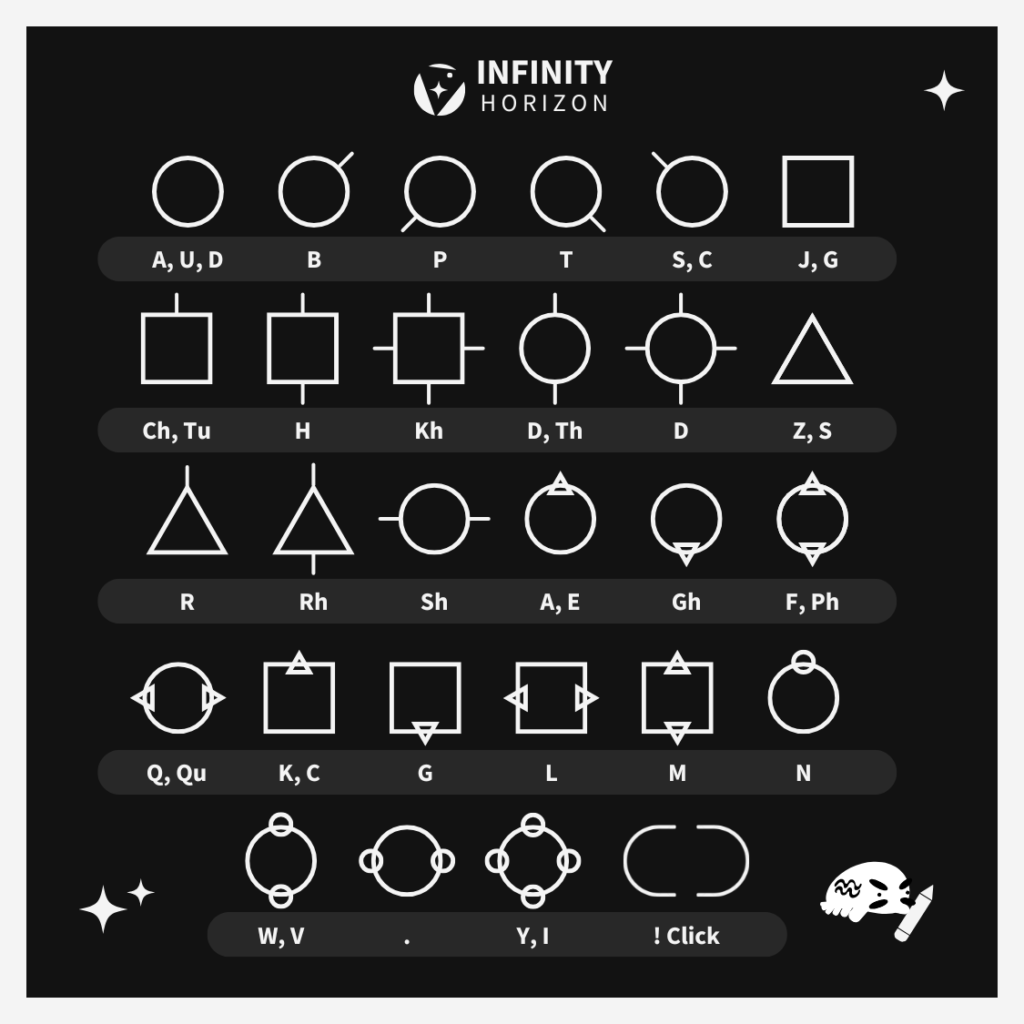
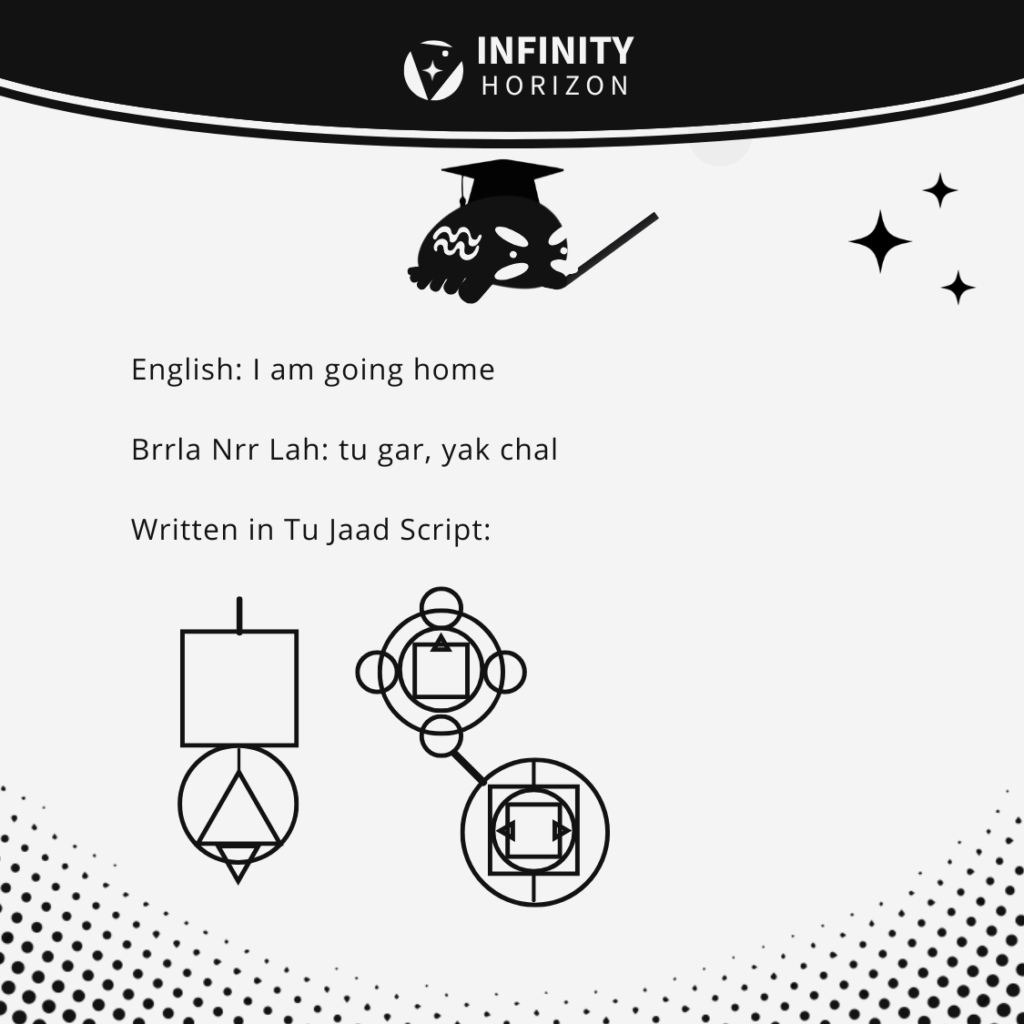
The Tu Jaad Script is the writing system of the Brrla Nrr Lah language. It is inspired by the shapes and patterns of crop circles, giving every word a unique geometric appearance.
Instead of using simple letters like the Latin alphabet, Tu Jaad is built from a small set of basic shapes, such as circles, squares, triangles, and short lines. Each shape represents a group of sounds, while extra lines or symbols change its pronunciation.
Characters are not always written separately. They are merged together to form one continuous symbol for a word. In turn, words in a single clause would be linked together. This makes each line look like a small geometric design rather than a row of letters.
The script was designed to be both easy to read and visually beautiful. Similar sounds have similar shapes, making it easier to learn. At the same time, every written word looks like a carefully drawn pattern.
Numbering System
Numbers: Brrla nrr lah has a limited numerical system composed of 6 primary numbers. Larger numbers can be described using combinations of these.
Basic Numbers:
Kali: 0
Ak: 1
Dak: 2
Damuti: 5 (from the Brrla nrr lah word for hand/five)
Eeri: 10 (representing many, used as the base for further combinations)
From 1 to 29, the primary are added using ”.”
e.g. 3 [2.1]
For larger numbers, primary numbers are multiplied using “!” and added “.”
e.g. 30 [2.1!10]
35 [2.1!10.5]
1000 [10!10!10]
Dictionary
!(Click)
particle: implies unconventional meaning
Example: Tu am!, yak (My ancestors)
A
Akss
noun: mirror, reflection, echo
adjective: opposite
verb: to reflect, to reverse
Ak
number: 1
noun: part (of smth)
adjective: united, married
verb: to unite, to marry
Am
noun: parent, creator, origin, caretaker, ancestor (unconventional)
verb: to create, to parent, to take care of
an
particle (at beginning of sentence): but, however
adjective: only
Atma
noun: air, essence, gas, soul or spirit (unconventional)
adjective: invisible, ephemeral, gaseous
Aray
noun: he, she, they, it
adjective: his, her, their, its
Aud
noun: eye, vision
adjective: …-looking, visual
verb: to look, to see, to read
pre-verb: to seek (to do something)
Aya
noun: event, arrival
adjective: arriving, coming, future, summoned
pre-verb: to become, to be in the process of (doing smth), to manage to, to succeed in
Aj
noun: hole, door, orifice, window (unconventional)
Anni
noun: parent, ancestor, creator, origin, caretaker
verb: to create, to parent, to take care of
Ayi
Adjective: meaning painful, suffering
So, medicine/cure would be Ayi-dafa
Aqiin
noun: back, behind, rear, butt
adjective: back, rear
Aja
noun: bread, grain, corn, rice, pizza (unconventional)
Agg
noun: heat, warmth, chemical reaction, heat source
adjective: warm, hot
verb: to heat
A!
noun: circle, ball, cycle, wheel, (with tenpo) year
adjective: round, circular, spherical, of one year
verb: to make a circle around, to surround
B
Bal
noun: long flexible object, string, rope, hair
Beela
noun/adjective: (the color) yellow (and its shades)
emotion: Cheerful
verb: to color smth yellow
Banna
verb: to hunt or gather
verb (unconventional): to search, to look for
Brrla
noun: speech, conversation, language
adjective: verbal, conversational
verb: to speak, to talk, to use language, to think
Bara
noun: size, greatness, vastness
adjective: big, giant, tall, great, important
verb: to grow
Buda
noun: lower part
adjective: bowing down, downward, lowly, humble, dependent
verb w/o obj: to bow down
verb w/ obj: to conquer, to defeat
Bech
noun: middle, center
adjective: average, moderate, mediocre
C
Cepa
noun: fish, marine animal, sea creature
Char
verb: to get, to take, to steal (unconventional)
Chatu
noun: smallness
adjective: small, few, young
verb: to shrink
Chez
noun: thing, object, matter
adjective: material, physical
Cude
noun: game, art
adjective: entertaining, artistic, amusing
verb: to amuse, to play, to have fun
Chal
noun: movement
adjective: moving
verb: to move
preposition: to, for, from perspective of
Chandi
noun: long solid object, branch, stick, length
adjective: long
Chashi
noun: want, need, desire
adjective: desired, needed, required
verb: to want smth
pre-verb: to want to do smth
D
d
interjection: um…, hm… (“thinking noise”)
Di
noun: spice, addition
adjective: additional, extra
verb: to add, to spice up
Dak
number: 2
noun: divide
adjective: divided
verb: to divide
Duur
noun: absence, remoteness
adjective: absent, away, remote
verb: remove, get rid of
Diti
noun: Pink,
emotion: love, compassion, admiration
adjective: loved, favorite, respected
verb: to love, to respect
Dard
noun: novelty, addition, update, improve
adjective: new, additional, fresh, extra
verb: to add, to update
Del
noun: land mammal, animal
Dafa
noun: end, finish
adjective: final, completed, finished, past (with tenpo)
verb: to end, to finish, to close
pre-verb: to end/stop doing something
Dihacha
noun: possessions, property
verb: to have/carry/contain/hold
Damuti
noun: hand, arm
number: 5
Dissem
noun: body, physical state, torso (unconventional)
adjective: physical, of sijelo
E
Eeri
noun: quantity
adjective: many, more
number: 10 or more
Engla
adjective: weird, unusual, strange, drunk
G
Ghun
noun: sound, noise
adjective: loud, noisy, sound-making
verb: to make noise, to recite, to play (an instrument)
Guzha
noun/adjective: red
emotion: Anger
verb: to color smth red
Ga
noun: earth, land, outdoors, territory, country
Gar
noun: house, building, structure, indoor space, room
adjective: indoor
Gau
noun: hill, mountain, button, bump, nose (unconventional)
adjective: hilly, mountainous, bumpy
Gg
noun: box, container, bowl, cup, drawer
verb (unconventional): to put in a box
Gam
noun: strength, power, energy
adjective: strong, powerful, energetic
H
Hunark
noun: ability, talent, possibility, liberty or one’s right (unconventional)
adjective: able, possible
pre-verb: can (do smth), may (do smth)
Heint
noun: heart, feeling, touch, sense
adjective: feeling, touch-based
verb: to touch, to think, to feel
I
Indar
noun: insides, contents, center, stomach (unconventional)
adjective: central, inside, between
J
J
noun: square, block, stairs (unconventional)
Jaad
noun: symbol, image, writing, script
adjective: symbolic, written, recorded
verb: to write, to draw, to record
Jane
noun: bird, flying creature
K
Kaa
noun: cloth, clothes, fabric, layer of privacy
adjective: clothed, made of cloth/fabric
verb: to clothe, to provide a layer of privacy
Kushi
noun: moon, star, night sky object
adjective: lunar, stellar
Kali
noun: nothing
adjective: not, no, empty
number: zero
Kaar
noun: start, beginning
adjective: initial, starting
verb: to start, to open, to turn on
pre-verb: to begin (doing something)
Kan
noun: ear, hearing
adjective: …-sounding
verb: to hear, to listen, to obey
Khrrb
adjective: epic, awesome
Kala
noun: black, shadow
Emotion: Depression or sadness
adjective: black, dark
verb: to color smth black, to cast a shadow
Keya
particle: what? which? (for questions)
L
Lah
noun: everything, universe
adjective: every, all, abundant
number: all/infinite
Lisan
noun: monster
adjective: scary, monstrous
verb: to scare, to be afraid of, (sometimes) to turn into a monster
Leenna
noun: sweets, fragrances
adjective: sweet, fragrant, cute, adorable
Lash
noun: time, moment, occasion
adjective: temporal
M
Madayam
noun: use, practice
verb w/ obj: to use smth
preposition: (do smth) using, with the help of
Mahal
noun: group, community, company, society, nation, tribe
adjective: communal, social
Mimu
noun: word, name
Munra
noun: face, foremost part, front, wall
adjective: of face, foremost
Mit
noun: powder, clay, paste, semi-solid, soil
Mixa
noun: similarity, (someone’s) sibling
adjective: similar, like, sibling
preposition: as, like
N
N
noun: eye
P
Payaj
noun: flat object, book, document, paper, page, record, website (unconventional)
adjective: flat
Verb: Flattening
Pii
noun: number
adjective: -th (ordinal indicator), mathematical, numeric, digital
Paar
noun: foot, leg, bottom, lower part, under (smth)
Phil
noun: mouth, lips
adjective: oral
Pitkar
noun: reptile
ph
particle: “if/when” (introduces context)
Paani
noun/adjective: water, fluid, liquid
adjective: wet, fluid, liquid
verb: to water, to clean
Pazaa
noun: money
adjective: valuable or wealthy
Pes
adjective: given, sent, released
verb: to give, to send, to emit, to release
Q
Qu
particle: and (combines subjects)
noun: sex
adjective: sexual
verb: Combining two things, to have sex with
R
Ralka
noun: one’s color, gender
adjective: colorful, painted
verb: to paint smth a color
Rrpprr
noun: difference, change, unconventional
adjective: different, other, changed
verb: to change
Rrk
noun: cause, reason, origin
adjective: original
verb w/ object (unconventional): to cause
preposition: from, because of
Rrza
noun: tool, machine, device
adjective: useful, artificial
Rula
noun: area above, top, highest part, sky, god
adjective: high, above, divine, sacred
S
noun: fruit, vegetable, mushroom (unconventional)
Spbdt
noun: head, mind
adjective: main, primary, controlling, ruling
verb: to head, to control or own, to direct, , to rule, to guide (unconventional)
Siid
noun: horizontal surface
Stunya
noun: stability, safety, wait (unconventional)
adjective: kept, stable, enduring, resilient, waiting or staying (unconventional)
verb: keep, stay, endure, protect
pre-verb: continue (doing something)
Sauji
noun: damage, mistake
adjective: broken, wrong
verb: to break, to make mistakes
particle: (generic curse)
Suwi
noun: path, road, street, directive, way, custom
adjective: street-, true to the directive/way/custom
verb: to guide, to show the path
Seena
noun: work, labor
adjective: working
verb: to work (on), to make
T
Thanda
noun: cold
adjective: cold, cool, raw or uncooked (unconventional)
verb: to cool down
Taca
noun: insect, bug
Tus
noun: you
adjective: your
Tamaf
noun: fight, battle, challenge, war
adjective: aggressive, warlike
verb: to fight, to battle, to challenge
Thyr
noun: hard object, metal, stone, solid
adjective: hard, metallic, solid
Tija
noun: trade, transaction, exchange
adjective: trade/exchange-related, commercial
verb: to trade, to exchange
Truna
noun: plant, leaf
Verb: To plant
Tu
particle: (specifies an object)
Tun
noun: sleep, rest
adjective: sleeping, restful
verb: to sleep, to rest
Tapa
noun: outer form, outer layer, shell, skin, boundary
adjective: outer
U
u
particle: very, really, also, confirmation (unconventional)
Ura
noun: sun, light, brightness, light source
adjective: solar, bright
verb: to light, to shine
Ufa
noun: the color white
Emotion: Peaceful
adjective: white, bright/light
verb: to color something white
Ubij
noun: death
adjective: dead, dying
verb: to kill
W
Waya
noun: person, people, humanity, beings
adjective: human-like, personal
Y
y
particle: (addressing people, commands)
ya
particle: or
Yla
noun: truth, life, existence
adjective: real, true, present, existing
verb w/o object: is true, exists
preposition: in, at, on
Yli
noun: woman, female, wife
adjective: feminine
Yak
noun: i, me, we, us
adjective: my, our
Ylu
noun: man, male, husband
adjective: masculine
Ye
noun/adjective: this, that
Yamyam
noun: food
adjective: edible, of food
verb: to eat, to drink, to swallow
Yash
noun: hip, side, nearby area
adjective: neighboring, nearby, at one’s side
Yazu
noun: good, simplicity
adjective: good, simple, friendly, peaceful
verb: to improve, to fix
Z
Zidari
noun: evil
adjective: bad, evil, unnecessary
verb: make smth worse, turn bad
Zindi
noun: dirt, waste
adjective: dirty, disgusting, toxic, unclean, unsanitary
verb: to make something dirty
Zarg
noun/adjective: blue, green
Emotion: Envy
verb: to color something blue/green
Zaura
noun: knowledge, information
adjective: known
verb: to know
pre-verb: to know (how to do something
Credit
A conlang by Artsy
Special credit
Moe Neus (Lore)
CrisPing (Visuals)
Zain (Research)